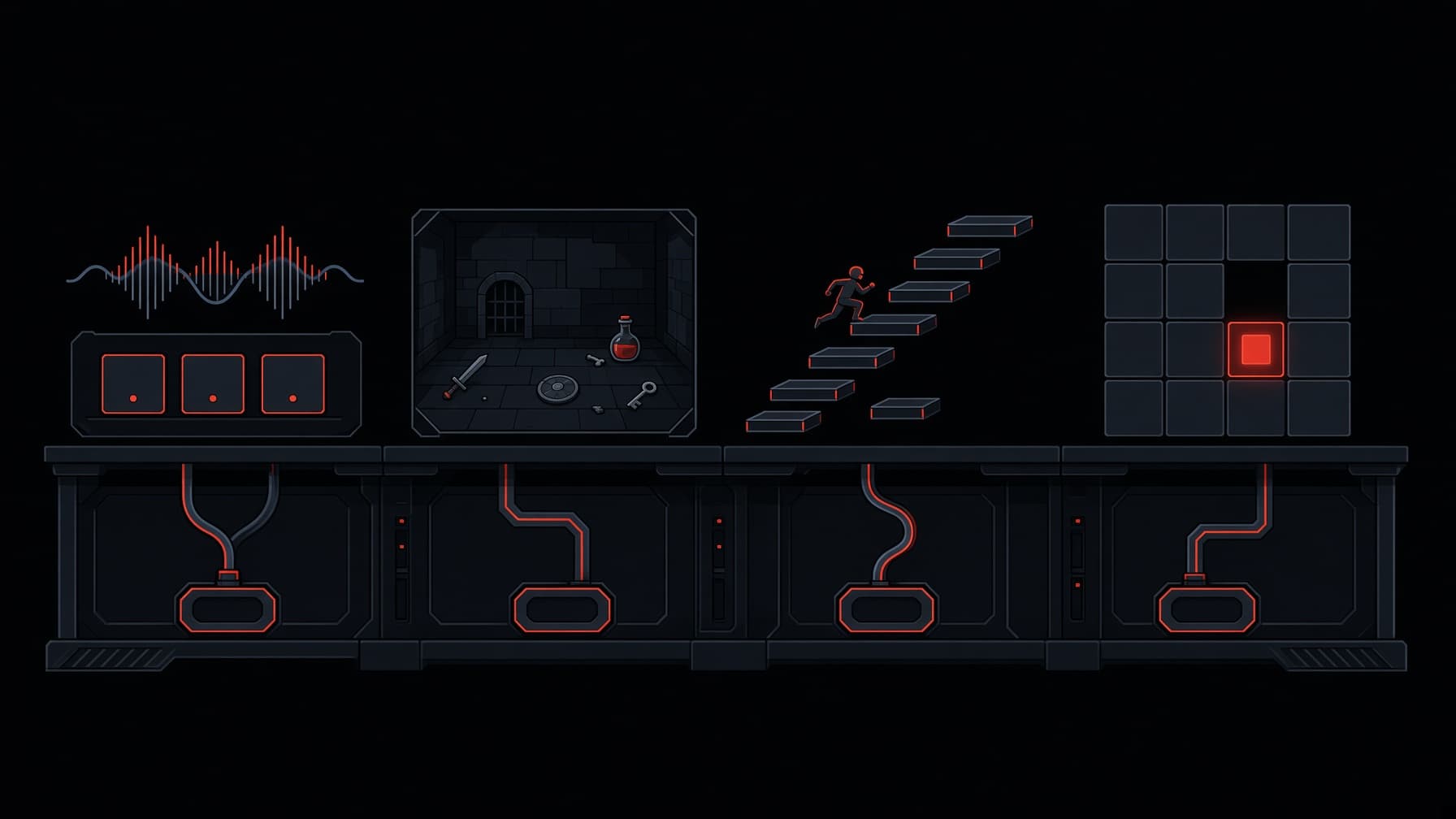
Best 2D Engine by Genre: Rhythm, Roguelike, Platformer
Rhythm games need audio-clock precision, roguelikes need iteration speed, platformers need deterministic physics. Pick by genre, not by feature list.
The best 2D engine is the one whose strengths match what your genre punishes. Rhythm games punish loose timing, roguelikes punish slow iteration, platformers punish physics you do not fully control, and puzzle games punish almost nothing, which is why they ship from every tool a developer has ever picked up. Yet when a beginner asks which engine to use for a first game, the advice that comes back in community threads is regularly some version of "learn C# first". That answers a different question, and it postpones the game. The engine question has a cheaper answer: start from the genre you are actually building and work backwards.
A disclosure before we start: this blog belongs to Egmatic, a no-code 2D editor in pre-alpha, and what that has to do with choosing by genre is near the end. If the term engine itself is still fuzzy, what a game engine actually does is the primer. The general framework for evaluating any engine, features, cost, community, is covered in how to choose a 2D game engine. This article is the narrower cut that saves the most time: given a genre, which engines have already shipped proven games in it, and what does that genre actually demand.
Quick answer
| Genre | What it demands from the engine | Engines with proven hits | Check before you commit |
|---|---|---|---|
| Rhythm | Sample-accurate audio clock, short input-to-sound latency | Unity (Muse Dash, Melatonin, Sayonara Wild Hearts), GameMaker (official music-sync tutorial) | Does the audio API expose a sample clock? Can players calibrate for their setup? |
| Roguelike, roguelite | Fast content iteration, data-driven items and enemies, save and meta systems | GameMaker (Spelunky), libGDX (Slay the Spire), LÖVE (Balatro), Godot (Dome Keeper, Brotato), Phaser then Unity (Vampire Survivors) | How many minutes to add one item, one enemy, one rule? |
| Platformer | Deterministic, frame-stable movement and collision you fully control | GameMaker (Pizza Tower, Katana Zero), Unity (Hollow Knight), C# on XNA (Celeste) | Fixed timestep? Collision code you can read and override? |
| Puzzle | Little raw performance; prototyping comfort and level workflow dominate | Multimedia Fusion 2 (Baba Is You), effectively anything | Level editor, undo, fastest path from idea to a link someone can play |
The pattern in the table is the whole method. Almost every 2D engine can technically make almost every 2D game, so feature checklists do not separate them. Genres do, because each genre has one demand the engine cannot fake and cannot fix later.
Why the genre decides the engine
An engine choice goes wrong in a specific way: you discover, six weeks in, that the thing your genre cannot live without is awkward in your tool. The rhythm game discovers its audio clock drifts. The roguelike discovers that adding one item takes an afternoon. The platformer discovers its jumps are slightly different at 30 and 60 frames per second, and players feel it without being able to name it.
So instead of asking which engine is best, ask what your genre is unforgiving about, then look at which engines have shipped games you respect in that exact genre. Shipped games are the strongest evidence an engine can offer, stronger than any roadmap or showcase reel, because they are survived costs. Every game named in this article is named because its engine is a matter of public record, and the pattern is deliberately messy: the same genre ships happily from a $0 framework and a subscription editor in the same year.
Rhythm games: the audio clock is the requirement
A rhythm game judges player actions against musical time, and it does so in windows measured in tens of milliseconds. That makes the engine's clock the single most important feature, and the clock that matters is not the frame counter.
Unity states this plainly in its own scripting reference for AudioSettings.dspTime: the value is "based on the actual number of samples the audio system processes and is therefore much more precise than the time obtained via the Time.time property". Judging beats by frame time means judging them against a clock that drifts independently of the sound card; judging them by the audio sample clock means the game and the music share one timebase. The shipped record backs the theory: Muse Dash, Sayonara Wild Hearts, and Melatonin, three well-known 2D rhythm games, were all built in Unity, and Melatonin was featured in Unity's own monthly roundup of made-with-Unity releases.
GameMaker belongs in the conversation too: its maker publishes an official tutorial on building a rhythm game around music synchronization, which tells you the route is supported rather than exotic.
The honest gap is the browser. If your plan includes a web build, and for an indie in 2026 it should, latency becomes a first-class design constraint. The Web Audio API lets you request a latency mode, interactive, balanced, or playback, but per the MDN documentation "the user agent may or may not choose to meet this request", and the true value only shows up in AudioContext.baseLatency after the context exists. In practice, the input-to-sound chain is longer in a browser tab than in a native build, and rhythm players notice. Prototype on the browser early, ship a latency calibration screen, and read how the developers of Crypt of the NecroDancer agonized over their beat windows before assuming your timing is generous enough; the window, not the engine, decides whether the game feels fair.
Roguelikes: iteration speed is the requirement
A roguelike's real cost is content volume multiplied by balance passes. The genre lives on hundreds of items, enemies, and rule interactions, so the engine question is really a workflow question: how many minutes does it take to add one more of anything, and how fast can you rebuild and replay after changing it?
The shipped record says the genre does not care about your engine's price tag. Spelunky, the game that re-anchored the modern roguelite, was built in GameMaker. Slay the Spire was built in libGDX, a free Java framework with no editor at all. Balatro, one of the breakout hits of its year, was built by one developer in LÖVE, a free Lua framework. Dome Keeper and Brotato were built in Godot, and Godot's own 2022 retrospective counts Brotato among its success stories. Vampire Survivors started as a Phaser web game and moved to Unity at version 1.6, a migration that began with the mobile builds and later enabled the online co-op update.
Read that list as a set, because it is the point: one genre, six engines, from a one-time-fee editor to a framework with no editor at all. What the winners shared was frictionless content: their data lived in tables and definitions they could extend quickly, their rebuild-and-test loop was fast, and their save and meta systems were simple to grow. When you evaluate an engine for a roguelike, ignore the rendering features and time yourself adding a third item to a game with two items.
If you are comparing the big free options for this kind of content pipeline, Godot vs Unity in 2026 covers the tradeoffs at length; the short genre verdict is that both ship roguelikes constantly and neither wins on the genre alone.
Platformers: determinism you can feel
Platformers are the genre where players physically feel the engine. Coyote time after leaving a ledge, a few frames of input buffering before a jump, jumps that travel the same arc at any frame rate: these are not luxuries, they are the genre's table stakes, and they all require the simulation to run on the developer's terms rather than the display's.
That is why the platformer record looks the way it does. Celeste, a byword for precise platforming, was built in C# on XNA, and XNA is a code framework rather than a managed engine: nothing in it moves a character for you, so every rule the feel rests on is code the team wrote and could tune. Hollow Knight shipped from Unity. Pizza Tower and Katana Zero shipped from GameMaker, and Spelunky, again, GameMaker: the engine is 2D-first and hands you movement and collision directly, which is exactly what a genre built on frame-exact jumps wants from its tools.
The practical checklist is short. Does the engine give you a fixed timestep or an equivalent, so physics advances in equal slices regardless of frame rate? Is collision code you can read, step through, and override, rather than a sealed physics body you tune by nudging parameters? Can you implement buffering and forgiveness yourself? GameMaker's answers are yes by design; Unity's are yes with discipline (its physics runs on a separate fixed update, and 2D platformer developers typically drive movement manually anyway); a no-code editor's answers need testing, because visual tools vary most in exactly this area.
For the craft layer on top of the engine, the tuning of jumps, hits, and pauses that makes movement satisfying, read how to make your game feel good, and for the levels the engine has to carry, level design for 2D platformers.
Puzzle games: the engine barely matters, the workflow does
Puzzle games are the genre with no engine horror story. Turn counts, rule states, and grid logic run comfortably on hardware from fifteen years ago, so performance eliminates nothing, and the deciding factors become purely human: how fast you can prototype a rule, how comfortably you can build and reorder levels, and how easily you can hand a build to a friend.
The proof this genre is tool-agnostic came from Hempuli's Baba Is You, built in Multimedia Fusion 2, an event-sheet authoring tool from the Clickteam line rather than a code-first engine, and still one of the most mechanically inventive puzzle games ever shipped. A visual, event-based tool carried a game whose rules rewrite themselves.
That makes puzzle games the natural home turf of no-code and low-code editors, and the evaluation question shifts to shipping: once the puzzle works, where does it live? A web link a tester can open in seconds is worth more than any rendering feature, which is why hosting a playable web demo belongs in your plan from the start. If you are surveying the no-code field itself, the best no-code 2D engines for indie developers is the dedicated comparison.
Shipping targets: the question that can outrank genre
The other engine question developers ask, sometimes before they have a game at all, is which engine gets them onto everything: iOS, Android, Steam, and Switch. Genre advice that ignores this is incomplete, because engines differ most exactly here.
| Engine | Web | Desktop | Mobile | Consoles | Cost to start |
|---|---|---|---|---|---|
| Unity | Yes | Yes | Yes | Official SDK path for approved developers | Free under $200K revenue and funding (Personal) |
| Godot 4.7 | Yes | Yes | Yes | Not in the engine's distribution; handled outside it | Free, MIT license |
| GameMaker | Yes, GX.games | Yes | Paid tiers | Enterprise licence plus console-maker approval; Switch since 2018, Switch 2 announced 2025 | Free for non-commercial; one-time fee for commercial |
| Construct 3 | HTML5-first | Yes | Yes | Through third-party porting partners | Free tier capped at 50 events, web export only; Individual $129.99/year |
| GDevelop | HTML5-first | Yes | Yes | Through third-party studios | Free tier; paid plans from €4.99/month |
Three cautions keep this table honest. First, "exports to consoles" never means "you can": every console requires you to become an approved developer with the platform holder before any engine's export button matters, and GameMaker's own console access guide says exactly that, pairing an Enterprise licence with per-platform authorization. Second, Godot's documentation itself routes console support outside the engine: its FAQ says to see the Godot website for information on console support, which in practice means third-party porting companies. Third, GDevelop's and Construct's publishing paths cover web, desktop, and mobile, with consoles reached through porting studios that specialize in exactly that.
And the store side has its own cost line: Steam itself charges a $100 recoupable fee per game through Steam Direct, a process walked through end to end in the Steam Direct publishing walkthrough.
A shorter way to choose
- Write down the one thing your genre cannot forgive: timing, iteration speed, determinism, or nothing.
- Take the two engines from that genre's shipped-hits column that fit your budget and coding comfort.
- Rebuild the hardest ten seconds of your game in each one. Not a menu, not a walk cycle: the beat, the run, the rule.
- Put the prototype on your weakest target platform on day one: an old phone, a browser tab, whatever will hurt first.
- Decide with shipping in mind, because where the game must live decides more than where it was most comfortable to build.
Common mistakes
- Choosing from feature lists. Every engine's marketing promises every game. Shipped titles in your genre are the only evidence that scales.
- Prototyping on desktop and discovering latency late. The rhythm game that feels perfect in the editor can feel wrong in a browser tab; the difference is measured in tens of milliseconds and it is design-visible.
- Reading "console export" as "I can ship to console". Platform-holder approval, and often a porting partner, sits in front of every console regardless of engine.
- Engine-hopping at 20 percent done. The second engine has the same hard part your genre owns; you will meet it again with less momentum.
- Treating the genre requirement as fixed. Prototypes drift: the roguelike becomes a puzzle game, the platformer becomes a rhythm runner. Re-run the one-question test when the game changes identity.
How Egmatic fits
Every engine above asks the genre question first and the shipping question later. Egmatic, the no-code 2D editor this blog belongs to, is being built in the opposite order: the core is genre-agnostic 2D, and the layer under active construction is the ship layer, so the scene you edit is already a build running in the engine that carries it to players at a link, with analytics attached, without code and without a backend of your own. For the genres in this article that changes the cheapest failure mode: the genre's non-negotiable, timing or iteration or determinism, is what you spend your attention on, and the testable-link part of the loop is not a second project.
The AI inside works as a craft amplifier under your direction: you decide what the game needs next, it executes, and every file stays yours. We will state the stage plainly: Egmatic is pre-alpha, we announce no dates we cannot keep, and the waitlist at egmatic.com is where you can tell us which genre you are building and what your current engine makes you pay for it, because requests arriving during pre-alpha are the ones that steer the build.
Pick the engine by genre. Ship the game without a second project.
Egmatic is a no-code 2D editor and engine whose ship layer carries builds to players at a link, with analytics, without code or a backend. Reply on the waitlist with the genre you are building and the part your current engine taxes: requests sent during pre-alpha are the ones that steer the build.
Conclusion
The best 2D engine by genre is not a ranking, it is a match. Rhythm games need an audio clock you trust, and Unity's shipped record plus its sample-accurate dspTime make it the default answer, with GameMaker a supported alternative. Roguelikes need iteration speed above all, and their winners come from everywhere: GameMaker, libGDX, LÖVE, Godot, and a Phaser-to-Unity journey that traded up for shipping reasons. Platformers need determinism you own, the territory of GameMaker, Unity with discipline, and code frameworks like the XNA foundation beneath Celeste. Puzzle games need almost nothing from the engine and everything from the workflow, which is how a Clickteam event-sheet tool produced Baba Is You. Name your genre's single unforgivable demand, weigh the engines that have already shipped in it, prototype the hardest ten seconds, and let your shipping targets break the tie.
Sources
- Wikipedia - Spelunky: engine listed as GameMaker Studio, genre platform game and roguelike
- Wikipedia - Pizza Tower (engine GameMaker) and Katana Zero (engine GameMaker Studio 2)
- Wikipedia - Celeste: engine listed as Microsoft XNA
- Wikipedia - Hollow Knight: engine Unity
- Wikipedia - Muse Dash, Sayonara Wild Hearts, Melatonin: engine Unity; Melatonin per Unity's Made with Unity monthly roundup, December 2022
- Wikipedia - Slay the Spire: engine libGDX, developer Mega Crit; Balatro: engine LÖVE, developer LocalThunk; Vampire Survivors: engine Phaser before version 1.6, Unity from 1.6 onwards
- Godot Engine - 2022: A Retrospective, listing Brotato among Godot success stories; Wikipedia - Dome Keeper and Cassette Beasts: engine Godot
- Wikipedia - Baba Is You: engine Multimedia Fusion 2, developer Hempuli
- Unity Scripting Reference - AudioSettings.dspTime: "based on the actual number of samples the audio system processes and is therefore much more precise than the time obtained via the Time.time property"
- MDN Web Docs - AudioContext(): latencyHint of "balanced", "interactive" or "playback"; "the user agent may or may not choose to meet this request"
- GameMaker - Which Platforms Can GameMaker Export To?, whose console access guidance pairs an Enterprise licence with per-platform developer authorization, and the GameMaker blog tutorial "Making A Rhythm Game In GameMaker" on music synchronization
- Godot Engine documentation - Frequently asked questions: "For information on console support, see the Godot website"
- GDevelop - Publishing games (web, desktop, mobile) and the GDevelop forum thread on console porting costs; Construct 3 manual - Publishing projects
- Game Developer - Game Design Deep Dive: Finding the beat in Crypt of the NecroDancer on designing beat windows
- Community reads, EGM feedback sweep 09-23: beginners advised to "learn C# first" before a first game, the pattern this article argues against
Related Posts
AI-Generated Game Flood: How Human-Made Indies Stay Visible
A third of 2026 Steam releases carry an AI disclosure. Here is what the flood takes from you, what it does not, and what still gets human-made games seen.
Best Game Dev Community Platforms Compared
Reddit brings reach, Discord your core players, engine forums the best answers, itch.io honest feedback on early builds. What each is for, and the cost.
How Do Browser Games Save Data Without a Server?
Browser games keep saves in localStorage and IndexedDB, storage the browser manages on the player's device. Here is how it works and when it fails.