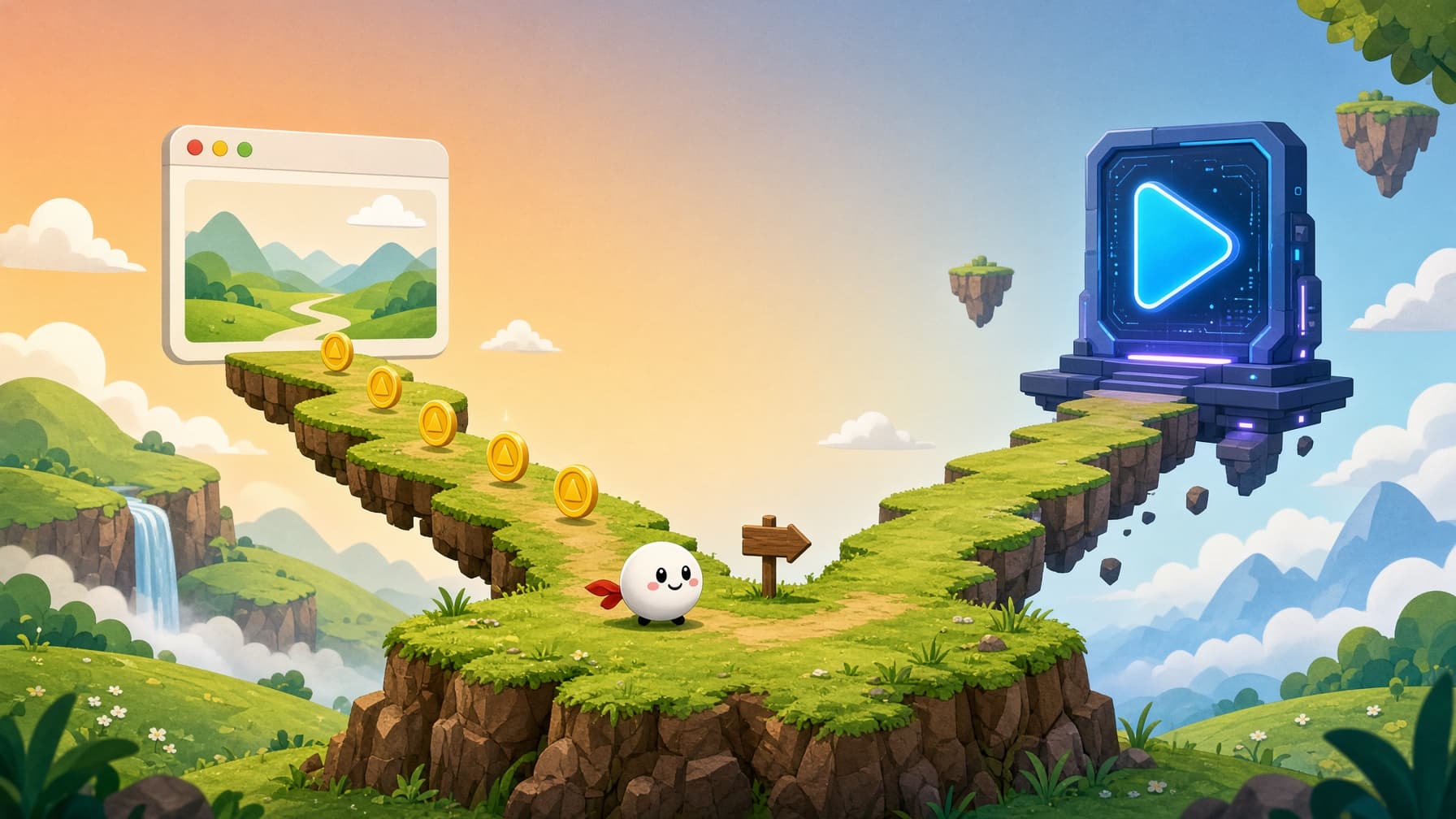
Browser Game or Steam? Where Your 2D Game Finds Players
Ship Steam as the product and keep a browser build as its marketing arm: audience, discovery, and monetization decide where a 2D game finds players.
Browser or Steam is not an export setting — it is a decision about which distribution model your game lives in, and the two models disagree about audience, money, and even whether your game still exists next year. Most 2D developers ask the question as "which build do I ship?", which hides the real choice: a browser game is a URL competing for attention with no storefront behind it, and a Steam game is a product inside the one PC storefront players actually open on purpose.
A disclosure up front: this blog belongs to Egmatic, a no-code 2D editor in pre-alpha built around the layer a game needs between Build and Launch — the ship layer. That work keeps us close to indie release decisions like this one, and everything below is engine-agnostic.
The short answer
For a 2D indie game, the working default is Steam as the product, the browser as its marketing arm. The comparison that gets you there:
| Factor | Browser build | Steam release |
|---|---|---|
| Friction to play | One click on a link | Store page → purchase → install |
| Audience | Whoever you send the URL to | Tens of millions who open the store to find games |
| Discovery | Your posts, jams, portals | Wishlists, demos, tags, recommendations, sales events |
| Monetization | Ads, F2P purchases, pay-what-you-want | Upfront sales at 70% (75%/80% at revenue tiers) |
| Persistence | Lives only while the URL and browser storage do | Installed on the player's machine |
| Upfront cost | Hosting only | $100 per game, recoupable at $1,000 adjusted gross |
Read the table as a division of labor, not a scoreboard. Every row where the browser wins — friction, cost — is a marketing advantage. Every row where Steam wins — audience, monetization, persistence — is a product advantage. The mistake is picking one side and expecting it to do both jobs.
Why "browser-only" fails as a default plan
In October 2026 an r/gamedev thread asked why more 2D games don't release as downloadable browser games, with FTL, Slay the Spire, and Terraria as the dream reference class. The answers from working developers were remarkably consistent, and they were not about technology.
The first answer is demand. As one developer put it plainly: "The real answer is just that the audience isn't there. Players are more willing to buy and play many games on mobile or Steam than they are in the browser." The web can distribute a game to anyone, but it cannot make anyone want to play it there.
The second answer is buying habits. PC players are conditioned to purchase in a storefront: "You can't sell browser games... consumers are not conditioned to it. Gamers buy games from Steam and sometimes GOG. If you aren't on Steam, you may as well not be selling it on PC." The same commenter described the habit loop — launch Steam, click the icon, play fullscreen — as something a browser tab never enters.
The third answer is retention. An icon on the desktop keeps a game in the player's life; a link does not: "You don't forget about a game when you have an icon on your desktop... You do forget about a game when you clicked a link a couple days ago." For a genre that lives on daily runs and long tails, that difference compounds.
Two smaller objections complete the picture: perception — many players still associate browser games with ads and data harvesting rather than "proper games" — and the fact that a browser build hands players the client-side source, making it the easiest build to copy outright.
None of these are arguments against a browser build. They are arguments against the browser being the whole plan.
What the browser is genuinely good at
Strip out the storefront expectations and the web is the best demo surface ever built:
- Zero-friction play. No install, no purchase, no account. A creator or journalist clicks one link and is playing your game in ten seconds — nothing else in game distribution does that.
- The jam circuit. The biggest game jams judge entries in the browser; a web build is how jam audiences actually play your work at all.
- The portal renaissance. Poki and CrazyGames host free browser games at real scale, with a working revenue model behind them — Poki's own description of the arrangement: "In order to keep our games completely free, we work with advertisers and share the revenue we make with the developers."
- Cheap experiments. As one developer in the same thread put it, the common practice for testing a new idea is to put the game on itch.io, playable in the browser. Fast feedback, no store paperwork, kill it in an afternoon if it's dead.
These are marketing and research jobs. The browser does them better than any store — which is exactly why it belongs in the plan.
What Steam gives you that the web can't
Steam's advantage is not the download; it's the concentration of intent. Millions of players open the store specifically to find something to play, and the platform supplies the machinery that converts them: wishlists that queue launch-day sales, demos and playtests, tags and recommendations, sale events, reviews, and the two-hour refund window that lowers the risk of buying from an unknown developer. Developers in the thread named the same list — better discovery, demo support, Steamworks networking, wishlists, release calendars — as the reason the store earns its cut.
The gate is low and knowable: a $100 Steam Direct fee per game, recoupable once the game passes $1,000 in adjusted gross revenue, with four to six weeks from signup to a launch-ready page. The full paperwork and store-page mechanics are covered in our Steam Direct publishing walkthrough. If you are weighing other stores alongside it, the economics comparison in Steam vs itch.io vs Epic breaks down each cut — Steam's 70/75/80 split against itch.io's default 10% and Epic's 12%.
That last pair of numbers is the honest footnote: Steam is not the cheapest store, and it is not the only one. It is the one with the audience, which is the entire point.
The persistence problem nobody plans for
A downloadable build, once installed, belongs to the player. A browser build is rented from three landlords at once: your hosting, the browser's storage policy, and the player's memory.
If your site goes down, the game is gone for everyone still playing it — a dependency no offline build has. Browser saves live in capped, evictable storage; Safari deletes script-writable storage after seven days without interaction, and private-browsing sessions discard it on exit. We keep a full breakdown of these limits in how browser games save data. For a demo this is fine. For a forty-hour game, it is a support ticket waiting to happen — another reason the deep version of the game belongs on the player's machine.
The hybrid that actually works
Put the two builds in one funnel:
- Build the Steam page first. Wishlists are the currency of a launch, and they accrue while you build.
- Ship a web build as the demo. Host it on itch.io or your own site — the mechanics of that are in how to host a playable web demo — and make it the link you attach to every post, reply, and press email.
- Put the wishlist link next to the Play button. Everyone who plays the free web version is one click from becoming a launch-day buyer.
- Treat web saves as disposable (or sync them), and let the Steam build be the one players keep.
This is not a compromise between the two options. It is each option doing the only job it is good at: the browser finds players, the store keeps them.
Where Egmatic fits
Egmatic is being built for exactly this last mile: you direct, it executes, you own the result. Our no-code, AI-native editor is aimed at the layer between a finished build and a live game — publishing, updates, saves, analytics — so the choice of where a build ships becomes a setting, not a second project. It is honestly pre-alpha; features arrive when they hold up, and we say so.
If you are deciding the distribution question for a 2D game right now, the waitlist at egmatic.com is where you weigh in on what the ship layer should handle — so it fits the funnel you actually chose, not a template.
Common mistakes
- Shipping browser-only to avoid the $100. The fee is recoupable at $1,000 adjusted gross; skipping the storefront to dodge it trades a real audience for a refundable deposit.
- Trying to sell per-copy on the web. No storefront, no buying habit, no refunds framework — the browser pays through ads, F2P, or donations, never through a checkout page players trust.
- Shipping the demo without the wishlist link. A playable web build with no path back to the store page is marketing with the conversion step deleted.
- Assuming the URL is permanent. Hosting lapses, storage gets evicted, links rot. The build players keep is the one they installed.
- Picking the platform before the design. A five-minute coffee-break game is a web game; a forty-hour roguelike needs an install and durable saves. Let the design vote first.
- Treating portals as a fallback. Poki and CrazyGames want free, fast-session F2P games built for that model — a portal placement is a distribution decision, not a consolation prize.
The takeaway
"Browser game or Steam?" is really two questions: where does your game get discovered, and where does it get kept. The browser wins discovery — one click, no gate, the best demo surface in existence — and loses everything that requires a storefront: buying habits, durable saves, an icon on the desktop. Steam is the inverse. For a 2D indie game the answer is almost never either/or: put the product on Steam, put the demo on the web, and connect the two with a wishlist button. The developers who ship both are not hedging — they are letting each platform do the one job it is unmistakably better at.
Related Posts
Steam Direct 2026: Complete Publishing Walkthrough
Steam Direct ships your game: sign, pay a $100 recoupable fee, build a store page, upload a build and pass review. Valve takes 30%; allow 4-6 weeks.
Steam vs itch.io vs Epic: Where to Sell Your Indie Game
Steam has the audience and takes 30% with a $100 fee. itch.io is open with a cut as low as 0% but far less traffic. Epic takes 12% and is more curated.
How to Host a Playable Web Demo of Your Game
Export a web build, drag the folder into itch.io, share the link: that is the whole job. Here is how itch.io, static hosts and portals compare.