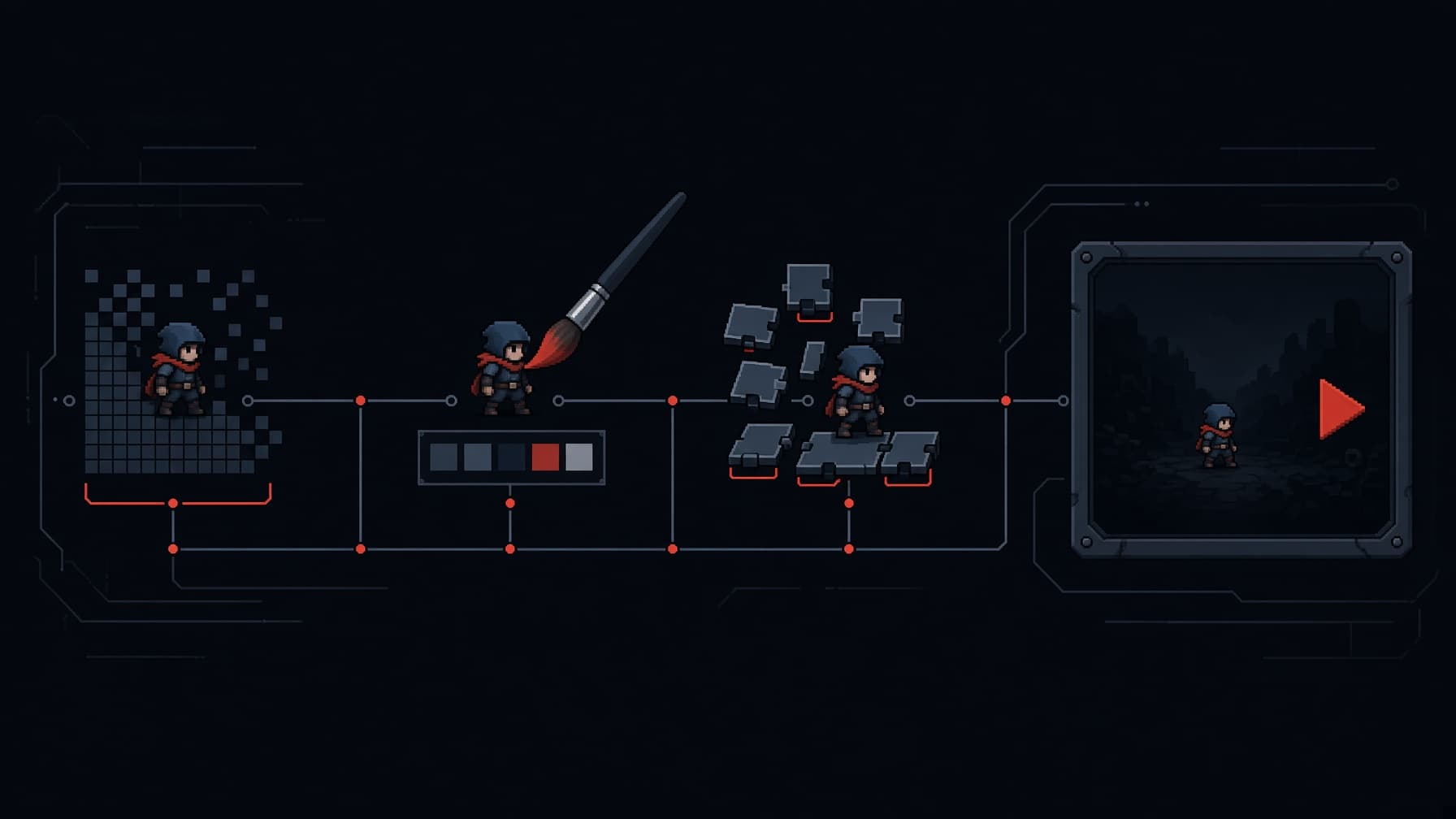
How to Get Game Art Without Drawing: Learn, Hire, or Borrow
Can't draw? Pick your art path by time, money, and style, not talent: learn the basics, hire a 2D artist, or borrow asset packs. 2026 prices.
Not being able to draw removes none of your options for getting game art; it just forces the decision that artists' clients postpone by default. Every developer who cannot draw ships by one of three routes: learn enough to make serviceable art yourself, pay someone to make it, or borrow it from asset packs. The routes have different costs in time, money, and style, and the failure mode is almost never picking the wrong one. It is drifting between all three while the game sits unfinished. This article is the decision map: what each path costs at 2026 prices, which criteria pick between them, and where mixing them holds up or falls apart.
A disclosure up front: this blog belongs to Egmatic, a no-code 2D editor in pre-alpha, and its stake in your art decision is near the end.
The short answer
| Your situation | The path that fits | First move |
|---|---|---|
| First game, you want it shipped | Borrow | One artist's free ecosystem (Kenney to start), one resolution, one palette |
| The look is the product; money exists | Hire | Commission the hero pieces, borrow everything else |
| You plan several games and art sounds like fun | Learn | Piskel tonight, 16x16 props, one month of practice |
| Deadline is close and style is secondary | Borrow, hard | Graybox now if it is not already, placeholder pass this week |
Three honest one-liners behind the table. Learning costs months and pays out from your second game onward. Hiring costs hundreds of dollars per asset and only makes sense once the project has proven it will be finished. Borrowing costs nothing and buys you everything except the exact picture in your head.
Why the forums cannot answer this for you
When a developer posts "I can't make the art for my game," the thread fills with the same three answers: learn, hire, use asset packs. A recent thread about being unable to make game textures collected forty-plus replies, and nearly every one of them reduces to that template. The asker stays stuck anyway, because the three answers are all correct. What the thread cannot supply is the criteria, since nobody asking knows their own constraints yet: how soon the game should be playable, how much money is actually available, whether the style is the selling point or just the wrapping, and how many games are coming after this one.
Those four questions decide the whole thing. The rest of this article turns each into numbers.
Learn: what it actually costs
The learning path has a false reputation for requiring talent. It requires time, and less of it than most people fear, because game art at indie scale is a set of constraints rather than freehand drawing.
The tools are free to start. Piskel runs in a browser with no installation, LibreSprite is a maintained free desktop editor, and Aseprite, the standard choice once animation becomes routine, is a $19.99 one-time purchase. What to practice is equally specific: small canvases (16x16 for props, 32x32 for a character), a borrowed fixed palette of 16 colors or fewer, and clean shapes. The beginner's guide to pixel art for games walks through that setup in order, and the free 2D art tools roundup compares the editors across styles.
The realistic timeline, for planning rather than motivation: a month of regular practice gets you serviceable props and readable icons; characters take longer, because silhouettes expose every weakness, and animating them takes longer again. Two properties of the skill matter for the decision. It compounds: everything from your twentieth sprite onward comes faster and better, which is why this path pays from the second game onward. And it does not speed up to professional pace: your twentieth sprite still takes an evening. If the game's deadline is measured in weeks, learning is not on the menu for this project; it is on the menu for your career.
Hire: what game art costs in 2026
Commissioned art is the path with the least mythology once you see current numbers. Two outsourcing studios published rate cards in 2026, and their figures agree on the shape.
| What you buy | Typical 2026 price | Source |
|---|---|---|
| Studio hour, US | $50–120 | Kevuru Games |
| Studio hour, Western Europe | $40–100 | Kevuru Games |
| Studio hour, Eastern Europe | $25–70 | Kevuru Games |
| Studio hour, Asia | $12–40 | Kevuru Games |
| Simple 2D character, concept + final | $300–800 | Whimsy Games |
| Detailed 2D character | $800–2,500 | Whimsy Games |
| Props and small assets | $50–300 | Kevuru Games |
Freelancers sit below these studio rates, and Kevuru's own caveat is the honest one: cheaper freelance rates come without guaranteed reliability or quality standards. For calibration in the other direction, an in-house 2D artist averages $59,523 per year in base pay on Glassdoor, which is why nobody's first game has one.
Two practices keep hiring sane. Pay per milestone or per asset set, a character set, a tileset, rather than hourly; buyers who have commissioned for years consistently prefer it, because it caps your risk while the artist keeps the upside of working fast. And budget your own time for art direction: a written brief with resolution, palette, references, and an asset list with animation frame counts. "Make it look cool" is how a $400 character becomes three revision rounds at $150 each.
When hiring is the right call: the project has proven it will be finished, the style is doing real selling work, and the money exists without betting the launch on it. Before that point, commissioned art is one of the reliable ways to spend money before earning any, a point the 2D game cost breakdown covers in detail.
Borrow: the free floor and the real price
The borrow path is the one most transformed in the last decade: the free floor now covers an entire game. itch.io listed 53,641 free game-asset packs in late August 2026, Kenney publishes a coherent catalog under CC0, and commercial use is allowed across most of the major libraries. The free game asset libraries guide maps them, including the part that actually bites: the license line next to each download decides what you may ship, per asset, not per library.
The real price of borrowing is not money; it is distinctiveness and seams. Games assembled from mixed packs argue with themselves on screen through mismatched outline weight, palette, and grid size, and packs from different authors never quite agree. The fixes are mechanical rather than artistic: pick one resolution and hold it everywhere, recolor imported packs into a single shared palette, and prefer complete ecosystems from one artist over the best sprite from each of five packs. Buying a paid pack from the artist whose free set you already use is the cheapest coherence available anywhere in game production; it costs pocket money.
What borrowing never gives you is the exact image in your head. If that image is the reason for the game, borrowing will fight you the whole way, and that is a style-centrality problem, not a discipline problem.
The decision frame
Four criteria, one table. Read your own situation down the columns; the path with the most matches is yours.
| Criterion | Learn | Hire | Borrow |
|---|---|---|---|
| Time to playable | Months available | Weeks available | This week |
| Budget for art | $0–20 (tools) | $300+ per asset | $0–30 |
| Style centrality | The craft is part of the appeal | The look sells the game | Coherent beats unique |
| Games ahead | Several | This one, seriously | This one, now |
| What you keep | A compounding skill | A distinctive product | A shipped game |
Two of the criteria deserve one more sentence each. Style centrality is the one people get wrong in both directions: a puzzle game with clean geometry needs almost no original art, while a narrative game about a specific character cannot borrow its protagonist. And "games ahead" is the compounding argument: if this game is the first of many, every month of art skill learned now pays interest for years, which can outweigh even a comfortable hire budget.
The standard indie pipeline is not a single path but a sequence: borrow while the game proves itself, then hire for the pieces that carry the store page. Mixing paths is legitimate; mixing sources is what breaks, and that distinction is the next section.
Where mixing works and where it breaks
The mix that works is layered: asset packs for the 90 percent of the game that is tiles, props, and UI, plus commissioned or hand-made hero pieces for the moments that carry the identity, the main character, the title screen, the trailer hook. This is cost control, not compromise, and shipped games do it constantly.
The mix that breaks is within a layer: characters from two authors, tiles from three. The seams show through outline weight, palette, and grid size, and players read the result as asset soup even when every individual piece is good. Three rules hold any mix together: one resolution everywhere, one shared palette with everything recolored into it, and single-source layers. When you commission hero pieces to sit beside a pack, send the pack itself as the style reference; artists match a concrete sheet far better than an adjective.
One ordering rule protects all of it: placeholder first, art second. A graybox build with placeholder shapes answers whether the game is worth arting, and the playtesting before art guide maps that ladder from paper prototype to first-pass art. Commissioning before the gameplay survives strangers is the most expensive version of skipping it.
Your first week on each path
Learn: open Piskel in a browser tonight and draw one 16x16 prop. Borrow a 16-color palette rather than inventing one. By day seven you will have a small sheet of props and a feel for whether the habit sticks; that feel is the actual data this decision needs.
Hire: do not open negotiations yet. Write the brief first: asset list with frame counts, resolution, palette file, style references, revision terms. Then commission one small paid test piece from a shortlist of two or three artists, judge speed and communication on it, and only then commit to a set.
Borrow: pick one free ecosystem and one resolution. Recolor everything you import into one palette. Keep a credits file with asset name, source, license, and download date per asset, starting with the first download, because the file only helps if it exists before you need it.
Common mistakes
- Commissioning before the game has proven it will be finished. The most reliable way to spend money before earning any; the borrow path exists to make the proof cheap.
- Learning on deadline art. Practice on props with no ship date attached; a hero character under a deadline is where beginners quit.
- Buying packs for games you are not making. Sale bundles are seductive and cumulative; a library of unused tiles is a museum, not a budget.
- Briefing artists with adjectives. "Dark, cozy, Ghibli-ish" produces three rounds of wrong; a pack screenshot plus a frame count produces one round of close.
- Treating AI generation as a fourth path that dissolves the decision. It lowers the floor for placeholders and one-off props and raises a new problem, style consistency across hundreds of assets, that lands right back on this same decision. Direct it, own its output, and keep its license records like any borrowed asset.
How Egmatic fits
The art path is secretly a shipping decision. Every route above ends with the same question: when does this game exist in front of strangers? Borrowing exists to answer "now," learning to answer "eventually, mine," hiring to answer "on budget." What none of them answer is the distance between finished art and a playable link, and that distance is where art decisions go to die.
Egmatic is a no-code 2D editor with a ship layer: the scene you are editing travels to a released game without code to maintain and without a backend to run, and the AI in the editor executes under your direction while every file stays yours. For the art decision, that means placeholder art is not a detour; it is the same pipeline the final art ships through, so swapping a borrowed tileset for a commissioned one never restarts the project. We are pre-alpha, we do not announce dates we cannot keep, and the waitlist at egmatic.com is where requests steer what gets built first.
Placeholder today, shipped game this year.
Pick your art path on purpose: borrow packs to prove the game, commission hero pieces when it deserves them. Egmatic is a no-code 2D editor with a ship layer that takes the scene you are editing to a released game without code or a backend. Reply on the waitlist with the art problem you want solved first; requests sent during pre-alpha steer the build.
Conclusion
"Can't draw" is a fact about your hands, not about your game. The decision that matters has four inputs: how soon the game should be playable, how much money exists for art, how much the style is the product, and how many games are coming after this one. Borrow covers a first game end to end for free and ships it fastest. Hire buys a distinctive product at $300–2,500 per hero asset, worth it exactly when the project is proven and the look does real selling. Learn costs a month to first props and compounds for years. Most shipped indie games sequence all three, and the sequence, borrow, prove, then hire, is safer than any single choice made early. The only wrong answer is the fourth path: waiting to decide.
Sources
- Kevuru Games — How Much Do 2D Art and 3D Art Cost, May 2026 (regional studio hourly rates for 2D art: US $50–120, Western Europe $40–100, Eastern Europe $25–70, Asia $12–40, based on Clutch studio listings; props $50–300, characters $200–1,500+; the freelancer caveat on reliability), retrieved October 20, 2026
- Whimsy Games — The Complete Guide to Game Art Outsourcing, March 2026 (2D character concept + final: $300–800 simple/casual, $800–2,500 mid-core/detailed; regional hourly context), retrieved October 20, 2026
- Kevuru Games — How to Hire 2D Artists (average base pay for in-house 2D artists at $59,523/year per Glassdoor; engagement models compared), retrieved October 20, 2026
- r/gamedev — Fair rates for game art assets? (buyers with years of commissioning experience describing the hourly bands they actually pay and their preference for milestone and per-set pricing; thread dates to 2014 and the practice pattern persists), retrieved October 20, 2026
- Community pattern as observed in EGM feedback sweeps, October 2026: a developer thread on being unable to make game textures drawing forty-plus replies, with nearly every answer reducing to the learn/hire/asset-packs template and none supplying decision criteria
- itch.io — free game assets browse (53,641 free game-asset packs listed, late August 2026), cross-checked in the EGM free asset libraries audit
Related Posts
Pixel Art vs Vector: Which 2D Art Style to Pick in 2026?
Pixel art vs vector for 2D games: pixel = hand-placed grid, retro feel, harder to scale; vector = math paths, sharp at any size. How to pick.
2D Scene Composition: Design Principles That Actually Work
Good composition makes a 2D game readable instantly: one focal point, strong value contrast, clear silhouettes, layered depth and balanced negative space.