How to Promote Your Indie Game Without the Cringe
Promote your indie game by participating, not broadcasting: answer questions, share builds in feedback threads, send devlogs. First-post scripts inside.
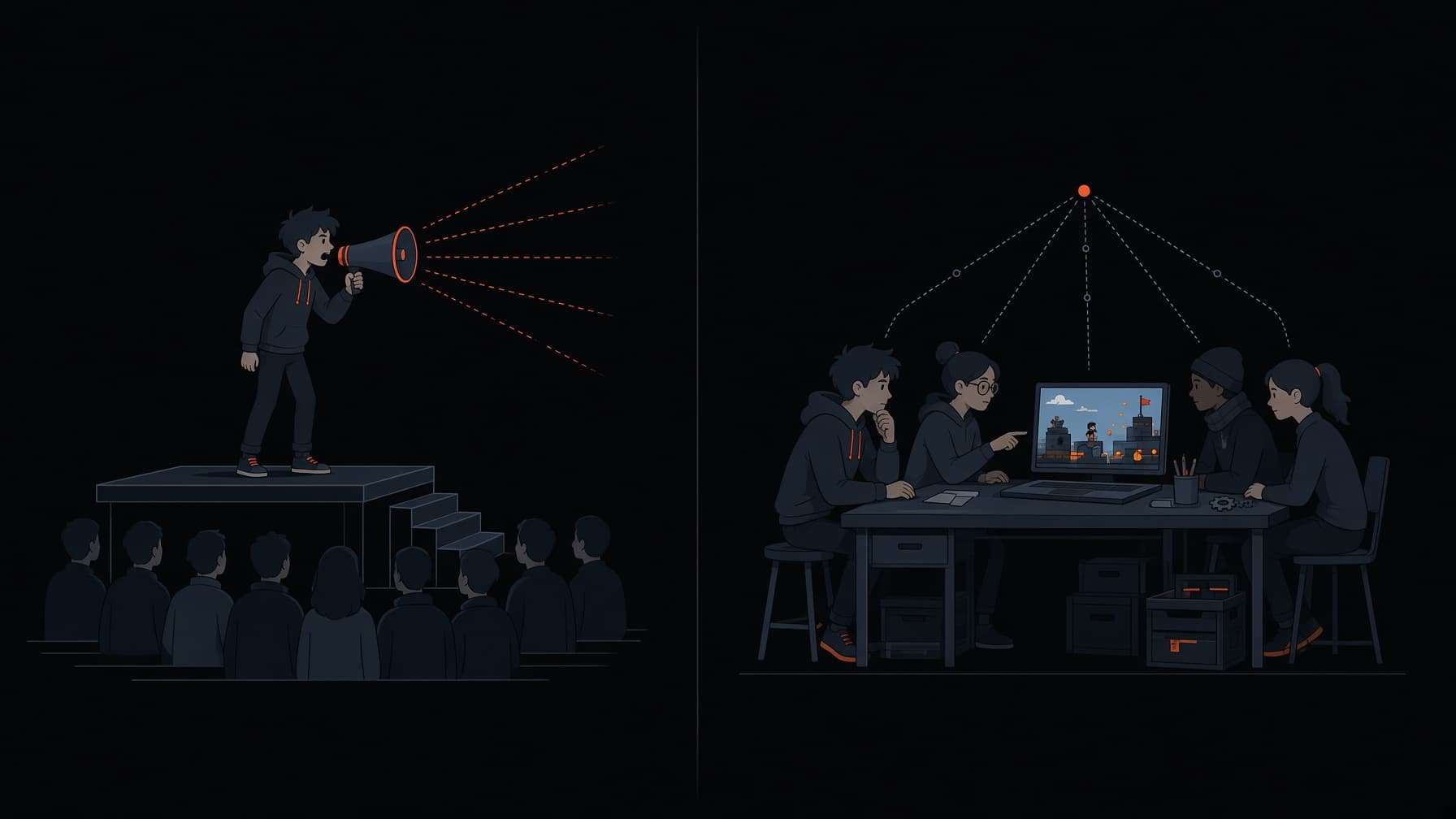
You do not have to become a marketer to promote your game, and the version of promotion you dread is mostly not the version that works. What developers describe as hating marketing is broadcasting: standing on a chair, announcing yourself to strangers who did not ask, and performing enthusiasm. Almost no solo developer has to do that. The reliable alternative is participation, answering questions, sharing builds in rooms built for sharing builds, and letting the game come up in context. This article walks the reframe, five scripts for your first posts, and a room-by-room map of where talking about your game is welcome, tolerated, or flatly banned.
The discomfort is not a fringe problem. In the subreddits and forums where indie developers gather, the same threads recur every week: someone's partner made a game and they have no idea how to make people know it exists, someone else admits they struggle with the "hey look at us!" part, a third asks how to actually advertise to a niche audience. The blocker is rarely a missing channel. It is nerve, and nerve responds to scripts and rules much better than to encouragement.
A disclosure up front: this blog belongs to Egmatic, a no-code 2D editor in pre-alpha, and what that has to do with marketing you hate is near the end.
The short answer
Three moves replace most of the broadcasting nobody enjoys:
- Swap the announcement for a contribution. A post that says "look at my game" asks for attention. A post that says "here is a build, here is what I am trying to learn from it" offers one. Same game, same room, different transaction.
- Post where the post is the point. Feedback threads, screenshot threads, playtest channels and devlog sections exist precisely so developers can show unfinished work without apology. Using them is not a loophole; it is the intended function.
- Talk about the work, not about yourself. "Devlog 4: rewriting pathfinding" is a subject people can care about. "I made something amazing" is a claim they have to evaluate. Keep yourself out of the sentence and the cringe leaves with you.
If your blocker is budget rather than nerve, the zero-budget marketing guide covers the channel map, and building a community before launch covers the longer game of earning a room. This piece is about the words and the rooms for the days when both feel impossible.
Why it feels so bad, and why it mostly is not
The cringe feeling has a mechanical cause: a context mismatch. You are making a one-way ask of strangers in a space that did not invite it, and everyone in the room, including you, can tell. That feeling is doing its job. The mistake is treating it as a verdict on promotion in general rather than on that one move.
Two facts soften the fear.
First, the sample of promoters you see is wildly skewed. The Nielsen Norman Group's long-running finding about online communities is that roughly 90 percent of people lurk, 9 percent react occasionally, and 1 percent create most of what you see. The confident, relentless self-promoters crowding your feed are that 1 percent. Silence is the norm, not the standard you are failing to clear. When you post quietly and reasonably, you are not competing with them; you are simply visible, which is the entire goal.
Second, the fear is usually fear of the zero-response post, and the zero-response post is the median outcome of the internet, not a signal about your game. A median Steam release sells about 100 copies in a market where a third of releases sell none at all. Silence after a post is the default state of the medium, not a verdict. The zero-response post is survivable, and it is easier to survive with a script than with courage.
Participation beats broadcasting
Broadcasting and participation are not two tones of the same activity; they are two different transactions. A broadcast interrupts a large, random audience to convert a tiny fraction. A contribution lands in front of a small, self-selected audience that cares about the exact thing you are contributing: the engine quirk you just fought, the genre you are working in, the tool you just learned. For a solo developer, the second audience is not smaller in the way that matters. It is denser.
This is not a consolation prize for shy people; it is in the professional playbook. Chris Zukowski, whose site How To Market A Game has become the standard reference for indie Steam marketing, opens his ten-step plan by pointing out that most marketing lists start with "get on social media and tweet about your game," and that this skips the most important part: knowing who actually wants your game. One of his ten steps reads, almost verbatim, "network with platform holders and other devs." The professionals build relationships in rooms. The amateurs buy megaphones.
The touches that follow are all legitimate, and only one of them is an ask:
| Touch | What you give | What you may ask | Where it lives |
|---|---|---|---|
| Feedback-thread post | A playable build and a specific question | Feedback on it | r/gamedev's Feedback Friday, feedback-exchange subreddits |
| Devlog | A real problem and how you solved it | Attention, compounded over time | Your itch.io project page, devlog channels, your site |
| Playtest invitation | Early access to the game | Playtime and notes | Discord playtest channels, communities you belong to |
| Answering questions | Hard-won experience with a tool or genre | Nothing directly | Forums and subreddits you already read |
| Launch post | The finished thing and its story | Wishlists, a look | Launch spaces, festivals, press, your mailing list |
Five scripts for the first posts
Scripts work because they move the task from identity ("am I the kind of person who promotes?") to execution ("do I have the words?"). Take these and replace the bracketed parts.
1. The feedback-thread post. One build, one specific question, an honest scope.
[Genre with a twist in one clause]. [Web build, X minutes of play]. I'm testing whether [one specific thing players can check], specifically [narrow it further]. Roast [one more thing you suspect is weak] too.
The specificity is the politeness. "Any feedback welcome" transfers the work to the reader; "does the wave 7-10 ramp feel fair or random" gives them a job they can actually do.
2. The screenshot-thread post. One line of context, one gif or screenshot, what changed.
[What it is]. [What changed since last week]. Next: [what comes next].
That is the whole format. Screenshot Saturday lives on r/gamedevscreens, a subreddit whose entire purpose is work-in-progress shots, with screenshot threads running on r/gamedev as well; the artifact carries the post, and the "what's next" line is what makes people follow the story.
3. Devlog number one. A problem, not a promise.
I'm making [game] because [honest reason in one sentence]. This week the problem was [technical or design problem]. I tried [A] and [B]; [which one won and why]. Build attached for anyone who wants to break it.
Devlogs compound: the first one gets three readers, the tenth gets passed around, because a solved problem is searchable and an announcement is not.
4. The playtest invitation. Small, bounded, no feedback form.
Looking for [small number] people to play [X minutes] of [genre] this weekend. You get a build link. I'm watching for one thing: [the single question]. I'll ask you three questions after, that's the whole obligation.
The playtester recruitment guide covers where to find more of them and how to run the session; the script above is the door-opener.
5. The answer that mentions the game. Only after you have fully answered someone's question, in a thread you would have read anyway.
[Complete, useful answer to their question.] That's how I ended up solving it in my own [genre] project, which is the only reason I had to learn this.
The game is context, not cargo. This is the single highest-trust touch available to a quiet developer, and it costs nothing but the knowledge you already have.
One more, outside the public rooms: telling family and friends. "I made a game. It's about [one sentence]. It isn't finished and I'm not selling anything today, but if you want to see it, here it is." Permission instead of pitch. Some of those people become your first playtesters, and one of them usually knows a community you should be in.
Where talking about your game is welcome, tolerated, or banned
| Room | The norm | What is safe to do |
|---|---|---|
| r/gamedev | No drive-by promotion; recurring threads are the sanctioned channel | Post in Feedback Friday and give feedback to others; screenshot threads for visuals |
| r/gamedevscreens | Showing work is the entire purpose | Post the gif with one line of context; skip the pitch entirely |
| r/playmygame | A feedback exchange; posting your game is the topic | A build plus the feedback you want; play other people's games too |
| Discord servers | Most have dedicated self-promo or playtest channels; links elsewhere often banned | Read the channel list literally; when unsure, ask a moderator once |
| itch.io devlog | Your own project page; followers see every entry | Anything honest; problems, fixes, progress; devlogs stack up over months |
| Steam community hub | People who already wishlisted or own the game | Patch notes, progress, what is coming; announce, don't beg |
| Your own site and mailing list | Yours outright, the only audience you own | Everything, and keep the useful-to-asky ratio high anyway |
If the table makes the landscape feel large, it is smaller than it looks: pick two rooms you would read even if you had no game, and work only those for a quarter. The community platforms guide compares the bigger rooms; the community-building guide covers running your own.
The give-before-ask ratio
No community publishes a number, but every community enforces one eventually. The pattern that stays welcome is simple: most of what you post should help someone else. In Feedback Friday the reciprocity is explicit, you are expected to play other people's builds to earn feedback on yours. Elsewhere it is implicit: your post history is the room's evidence of who you are, and communities read an account that only ever drops its own links in a second.
A workable personal rule is three gives for every ask, held loosely rather than audited. It is a heuristic, not a law; the moderators of each room are the law. The practical translation: for every post about your game, leave three comments that have nothing to do with it. You were going to read those threads anyway. Contributing to them is the cost, and it is denominated in minutes.
If you still cannot press Post
Some of the barrier is identity, and mechanics help with identity too.
- Write as the project, not as yourself. "Devlog 4: the pathfinding rewrite" reads neutral. "Look what I made" reads as exposure. Make the game the subject and yourself the narrator, and the sentence stops being about you.
- Use the smallest room first. Send the build to one friend, then the Discord channel, then the subreddit, then the front page of the internet. Ladder the audience instead of leaping to it.
- Never apologize for the plug. "Shameless plug, but..." frames your own post as a violation and invites exactly the judgment you fear. State the context, share the artifact, stop.
- Batch the writing. Thirty minutes on Sunday drafts the week's three posts. Posting becomes an administrative task instead of a courage event, and courage is the expensive ingredient.
- Pick a cadence you can survive. One devlog a week for eight weeks, then keep going. Consistency is what rooms read as seriousness, and bursts read as neediness.
The last item hides a dependency: a devlog a week requires something shipped to write about. When the loop from "made a change" to "playable link in the post" is long, the cadence dies first, and the marketing with it. That is the part worth tooling, and it is the reason this blog exists.
Common mistakes
- Starting on launch day. Visibility compounds from the first devlog, not from the store page going live. A store page up early plus eight devlogs beats eight launch-day posts into rooms that have never heard of you.
- Copying publisher hype. A trailer voice announcing the ultimate roguelike reads as a costume on a solo developer. Your actual voice, showing actual work, is the one asset a publisher cannot outspend you on.
- Being everywhere at once. Two rooms you genuinely inhabit will outperform six you are squatting. The channel map in the zero-budget guide helps you pick.
- Expecting posting to fix the game. Derek Yu's assessment has aged well: good marketing can widen a game's appeal "only to the maximum extent that the game itself will allow." If playtesters are confused, the lever is the game, and posting harder is the expensive way to learn that.
- Only posting when you need something. Launch, festival, sale, launch, festival, sale. Rooms notice the pattern and discount accordingly. The give-before-ask ratio exists to keep your asks expensive and rare.
How Egmatic fits
Participation marketing has a supply chain, and the supply is shipped progress: a build to link, a fix to document, a patch note that proves the devlog is real. When shipping a playable slice takes a week of setup, the cadence dies, and with it the only kind of promotion most developers can stomach.
Egmatic is a no-code 2D editor with a ship layer: the scene you are editing travels to a released game without code to maintain and without a backend to run, and the AI in the editor executes under your direction while every file stays yours. The loop this supports is short: change the game, cut a build, post the link, read what strangers do with it. We are pre-alpha, we do not announce dates we cannot keep, and the waitlist at egmatic.com is where requests steer what gets built first.
Post the build, not the broadcast.
The promotion most developers can live with is shipped progress: a devlog, a playtest build, a patch note. Egmatic is a no-code 2D editor with a ship layer that carries a scene to a released game without code or a backend. Reply on the waitlist with the post you keep not pressing publish on; requests sent during pre-alpha are the ones that steer the build.
Conclusion
The dread has a specific address: broadcasting, the one-way announcement to people who did not ask. You can decline it without declining visibility. Contribute where contribution is the norm, use scripts until the words are yours, give more than you ask, and put the game, not yourself, in the subject line. The five scripts above are enough for a month of posts, and a month is enough to find out which rooms are yours. The game does the talking. Your job is to keep putting it in rooms where talking is expected.
Sources
- Derek Yu — Indie Game Dev: Assessing Risk, marketing section (a game's broad appeal constrains what marketing can add; focus on the lowest-hanging fruit you can do from your computer), retrieved October 19, 2026
- Chris Zukowski, How To Market A Game — How To Market Your Indie Game: A 10 Step Plan, updated 2024 (most marketing lists begin with "get on social media and tweet about your game," which skips identifying who wants your game; networking with other developers as an explicit step), retrieved October 19, 2026
- Jakob Nielsen, Nielsen Norman Group — Participation Inequality: Encouraging More Users to Contribute, 2006 (the 90-9-1 split: roughly 90 percent of community members lurk, 9 percent contribute occasionally, 1 percent create most content)
- Community self-regulation as observed in practice: r/gamedev's recurring Feedback Friday and Screenshot Saturday threads (with the give-feedback-to-get-feedback norm), r/gamedevscreens, and feedback-exchange subreddits such as r/playmygame
Related Posts
AI-Generated Game Flood: How Human-Made Indies Stay Visible
A third of 2026 Steam releases carry an AI disclosure. Here is what the flood takes from you, what it does not, and what still gets human-made games seen.
Best 2D Engine by Genre: Rhythm, Roguelike, Platformer
Rhythm games need audio-clock precision, roguelikes need iteration speed, platformers need deterministic physics. Pick by genre, not by feature list.
Best Game Dev Community Platforms Compared
Reddit brings reach, Discord your core players, engine forums the best answers, itch.io honest feedback on early builds. What each is for, and the cost.